


Garden's Pulse Heirloom Seed Vault Kit (35 Varieties)
Garden's Pulse Heirloom Seed Vault Kit (35 Varieties)
Couldn't load pickup availability

Garden's Pulse Heirloom Seed Vault Kit (35 Varieties)
- Apple pay payment method
- Bancontact payment method
- Bizum payment method
- Diners club payment method
- Google pay payment method
- Ideal payment method
- Master payment method
- Mbway payment method
- Paypal payment method
- Satispay payment method
- Shopify pay payment method
- Venmo payment method
- Visa payment method
Worth having on hand
Seeds do the growing. These are the things that keep them alive long enough to do it. None of it is required — adding something here won't replace your vault or skip you to checkout.


What's Inside the Vault
What's Inside the Vault
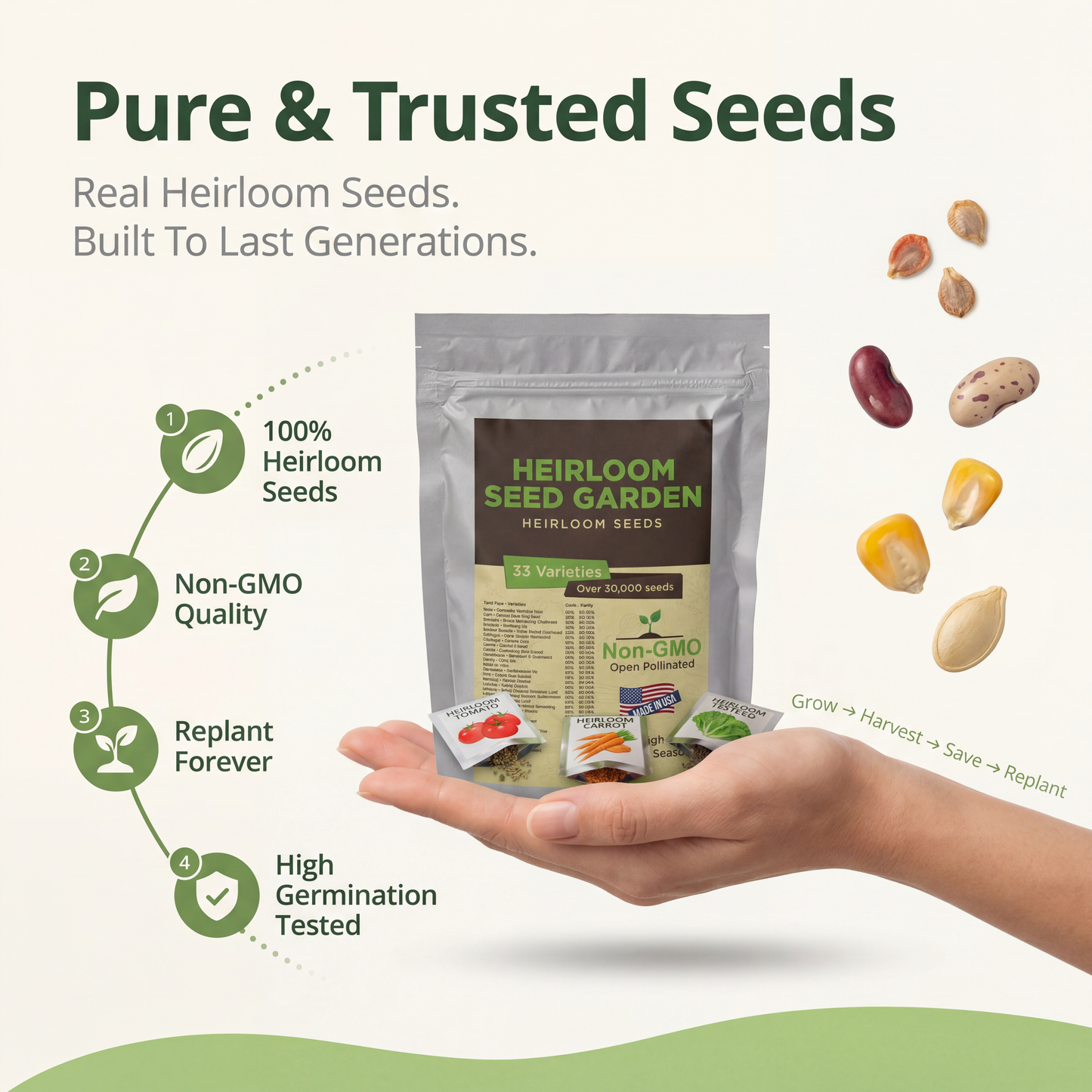
35 hand-selected heirloom seed varieties including tomatoes, peppers, lettuce, kale, basil, cilantro, carrots, radishes, cucumbers, squash, beans, and more. Every packet is individually labeled with variety name, planting depth, spacing, sun requirements, and days to harvest.
- 16,000+ total seeds across 35 varieties
- Each packet is resealable and individually labeled
- Includes a mix of vegetables, herbs, and greens
- Curated for home garden productivity and everyday cooking

Seed Quality & Standards
Seed Quality & Standards
All seeds are sourced from trusted growers and tested for viability before packaging.
- 100% heirloom and open-pollinated
- Non-GMO — no genetically modified organisms
- No hybrid varieties — every seed reproduces true to type
- High germination rate across all varieties
How It Works
How It Works
Choose your varieties based on your climate zone and available space. Follow the simple planting guide on each packet. Plant in raised beds, containers, window boxes, or directly in your backyard. Water regularly, harvest when ready, and save seeds from your healthiest plants to replant next season — and every season after that.
How Long Before I See Results?
How Long Before I See Results?
Most fast-growing varieties like lettuce, radishes, and herbs will sprout within 7–14 days. Tomatoes, peppers, and squash typically take 2–4 weeks to establish strong seedlings. First harvests begin around week 5–8 depending on the variety and your growing conditions.
Many customers report their fullest harvests by the second season, once they've learned their soil and saved seeds from their best plants.
Storage & Freshness
Storage & Freshness
All seeds are sealed in airtight, moisture-resistant pouches designed for long-term storage. Store in a cool, dry place for maximum viability.
- 10-Year Freshness when stored properly
- Plant this spring or store for years — your seeds will be ready
- Ideal for emergency preparedness and long-term food planning


30 crops. 35 varieties. Every one named.
Anyone can write “35 heirloom varieties.” Here is the actual list, by cultivar. Four crops ship as more than one variety — three lettuces, two tomatoes, two radishes, two beans — which is how 30 crops become 35 packets.


Substitutions may occur with harvest availability; any substitute is an equivalent open-pollinated heirloom variety.
All 13 USDA zones. The only question is what, and when.
Everything in this kit is all you need. Hardiness zones measure how cold a winter gets — which matters for trees and shrubs that have to live through it. Garden vegetables don't: they go in after your last frost and come out before your first. So the zone number isn't what decides your garden. Your frost-free window is.
The Garden Planner gives you sowing and harvest dates for your own zone, so you're not guessing at the calendar.
First harvest in about a month.
You don't wait a whole season to find out whether it worked. The fastest crops are on the table inside 30 days — and by the time the tomatoes come in, you've been eating out of the garden for two months.

Days from sowing to first harvest under typical conditions. Varies with zone, soil, water and weather.
Four questions — and you should ask them of this one too.
The category is crowded and most of it is decoration. Hobby packets with fifteen seeds in them. Kits labelled for emergencies that turn out to be the same hybrids in a scarier box. Four questions sort it out in about ninety seconds.

Run those four against anything you're considering — including this page. If a seller won't answer all four in writing, before you pay, don't buy it.
What customers report after their first season.
Real Stories, Real Results


-
"These are the seeds my grandmother used to grow."
For years I tried keeping my grandmother's garden going with seeds from the hardware store. They never worked the same way — things grew differently, tasted different, and I could never save seeds that actually reproduced. Then I found Garden's Pulse. First season, everything grew exactly the way I remembered from her garden. The tomatoes, the basil, the peppers — all of it. Second season, I replanted entirely from my own saved seeds and the results were just as strong. I actually got emotional the first time I harvested from seeds I saved myself. This is what real gardening is supposed to be. My grandmother would have loved this kit.

-
"Way better than anything I've bought at Home Depot."
I've wasted more money than I'd like to admit on seed kits from big box stores. Half the packets wouldn't germinate, the instructions were vague, and the varieties felt random — like they just threw whatever was cheapest into a bag. Garden's Pulse is completely different. You can tell this was put together by people who actually garden. The varieties make sense for everyday cooking, every packet is clearly labeled, and the germination rate has been outstanding. I've already saved seeds from my first harvest of tomatoes and cucumbers and I'm replanting this spring. This is the last seed kit I'll ever need to buy, and I mean that literally.

-
"We bought this for our whole family — and then bought more."
We run a small homestead in Kentucky and this kit has become a staple in our operation. All the classic vegetables are included — tomatoes, peppers, lettuce, kale, beans, squash — plus herbs and extras we normally forget to buy separately. The germination rate has been the best we've ever experienced with any seed kit, hands down. What sold us was the fact that every variety is open-pollinated. We saved seeds from our healthiest plants last season and replanted them this year with zero drop in quality. We've since bought three more kits — one for my parents, one for my sister's family, and one for long-term storage. This is how our grandparents did it, and it's how we're doing it now.


Test it. Don't just keep it.
Most guarantees ask you to decide whether you're happy. This one asks you to run a check — because that's how seed is actually judged, and because we'd rather you found out in week one than in year three.
Every dollar back, and keep both guides.
If the germination doesn't satisfy you — or the kit isn't what this page said it was — email support inside 90 days for a full refund. The manual and the Garden Planner are yours either way.

Questions people actually ask.
What makes these different from seed packets at a garden centre?
Most retail seed is hybrid, bred for a strong uniform first generation. Save the seed off it and you hit F2 breakdown: traits segregate, plants come up uneven, and much of it doesn't come up at all — so you buy again next year. Every variety here is open-pollinated. Save it, replant it, it comes back true.
Will these grow where I live?
Yes. Hardiness zones measure winter cold, and these crops never see winter — they go in after your last frost and come out before your first. What varies by zone is the length of your frost-free window, and the Garden Planner gives you sowing and harvest dates for yours.
I've never grown anything. Is this beginner-friendly?
It's built on the assumption you haven't. Planting instructions are printed on every packet, and both guides are written for someone starting from zero. In post-purchase surveys 90% said it was easy with no prior experience. Radishes and leaf lettuce are picking inside 30 days, so you get a result fast.
How long can it sit before I plant it?
Storage life varies by seed variety and storage conditions. Keep seeds cool and dry, and follow any planting or storage dates supplied with your seeds.
How do I actually save the seed?
It isn't hard, but it is specific: some crops you take at eating stage, some you let go well past it, some dry on the plant, and a few need washing and a few days of fermenting. The Garden Planner has the schedule crop by crop. That guide is the reason one purchase becomes every year after.
Why would I buy more than one?
A seed line stored in one place isn't a seed line, it's a box. Roughly a third of orders are three kits — for adult children in other states, for parents, for a sister's household, or simply to keep one sealed while another gets used.
Is 50% off real, or a permanent sale?
It's the batch price. Seed is grown out, harvested, germination-tested and packed in dated batches, and each batch is priced to clear before the next grow-out arrives. When this one is gone it's gone until the next harvest is tested and packed, and the price resets with it.
What if nothing comes up?
Every dollar back. You have 90 days: open it, pull three packets, sow a short test bed and count the rows on day eight. If it doesn't satisfy you, email support. You keep both guides regardless.